
AI-Enabled Enterprise Workforce
Operationalizing Institutional Intelligence

AI will create jobs. This will happen when AI moves beyond individual productivity and becomes embedded in enterprise workflows, decisions, agents, products, and operating models.
The true AI transformation restructures human work. It moves human responsibility to different layers of the enterprise. As AI begins to interpret context, generate outputs, recommend actions, and participate in workflows, humans become more important in the places where meaning is defined, judgment is applied, risk is accepted, governance is operationalized, and accountability is preserved.
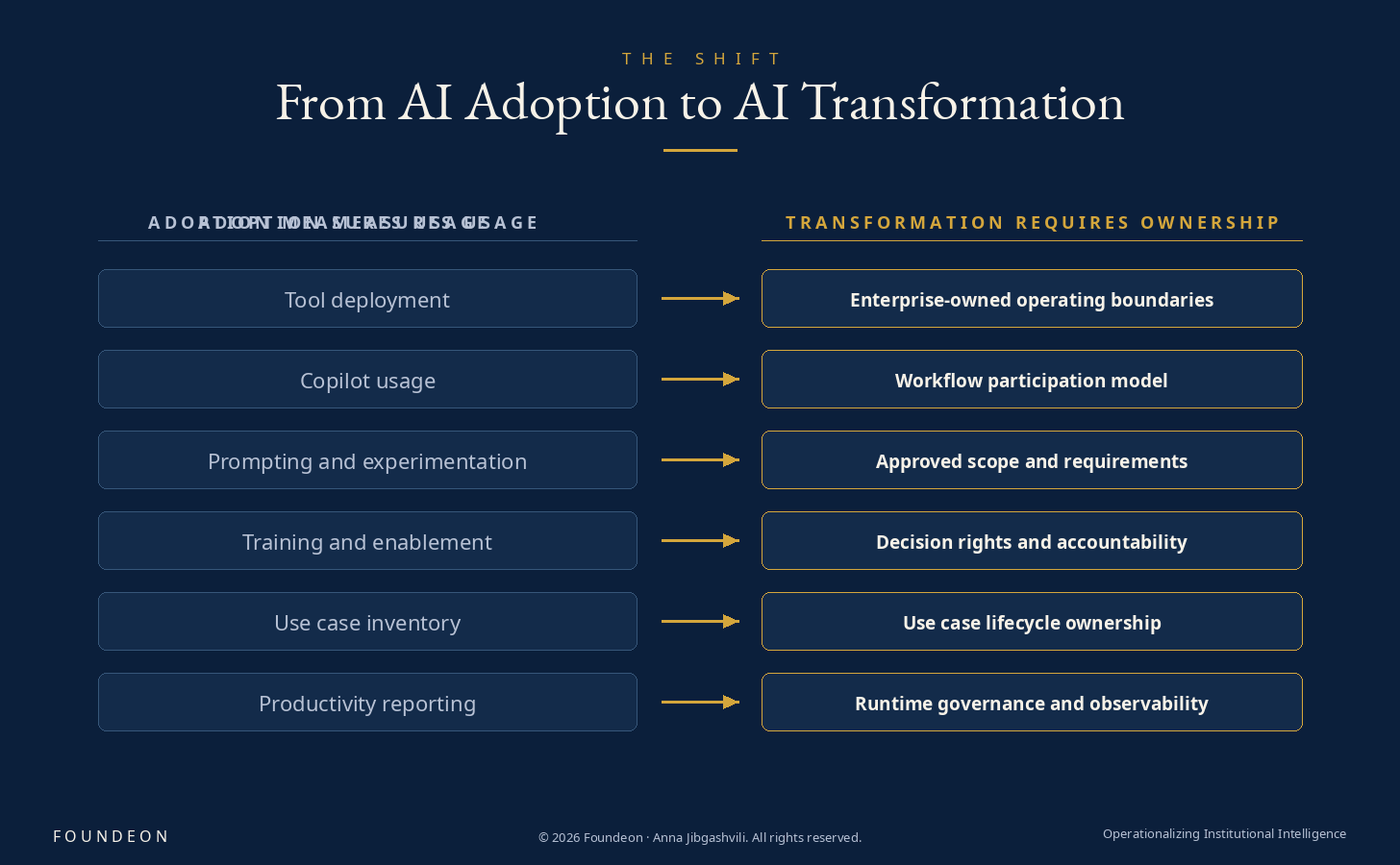
AI adoption is people using the tools.
AI transformation is the redesign of the enterprise operating model around explicit ownership of what AI is allowed to consume, influence, decide, escalate, and change. It restructures workflows, decision rights, governance, and accountability so that AI operates inside boundaries the enterprise has deliberately defined, on foundations the enterprise has certified, with consequences the enterprise has agreed to own.
This article builds on two earlier parts of the same workforce shift. In the first, I wrote about the Chief AI Officer as a role that should own AI as an enterprise operating capability, not only as a portfolio of tools. In the second, I wrote about how product management changes when AI moves from feature delivery into workflow, decision, and capability design. This piece extends that argument into the broader enterprise workforce: the roles, responsibilities, and ownership points that become visible when AI transformation becomes real.
That definition sets a high bar, and the bar is the point. Early AI programs emphasize training, experimentation, usage, and productivity. Teams learn how to use copilots, write prompts, automate tasks, and identify use cases. That stage is necessary, and it is a stage. Once AI becomes part of real workflows and decisions, the question becomes: Who approves the use case? Who owns the business logic? Who confirms the trusted foundation is ready? Who signs off on requirements? Who defines what an agent is allowed to do? Who tests edge cases? Who monitors behavior after deployment? Who handles exceptions? Who accepts risk? Who remains accountable when something goes wrong?
That is where the workforce conversation needs to move beyond “AI users.” The future enterprise will need people who can govern AI as an operating capability.
In my work through Foundeon, I have mapped 115 roles across 15 lifecycle layers of AI transformation. The number itself is the wrong takeaway. Those are capabilities, not job titles, and the map is illustrative. Workflows are structured differently in every enterprise, and the roles that emerge will follow them. In practice, these capabilities begin bundled into existing functions, supported by agents, and consolidated into a small operating cell. The map exists to make the responsibilities visible so ownership can be assigned.
A note on scope: the roles described here are derived from Foundeon’s transformation architecture work and enterprise pattern recognition. The specific roles any enterprise needs emerge from its workflows, risk profile, and operating model.
How to read the role map
AI transformation creates a new set of enterprise capabilities. Some will become formal roles. Some will be combined into existing functions. Some will be supported by AI agents. Each capability needs a clearly assigned human owner.
The critical question is whether the enterprise has assigned ownership of the work AI transformation requires: intake, requirements, trusted foundation readiness, decision authority, testing, observability, escalation, approval, auditability, recertification, and retirement. Separate hiring for each role is a downstream decision.
In practice, enterprises organize these responsibilities in three ways.
Formal roles. Dedicated positions created when the capability becomes material, recurring, regulated, or enterprise-critical.
Combined responsibilities. Capabilities assigned to existing leaders, product owners, governance teams, data owners, risk partners, or transformation teams. A product owner may carry part of the responsibility for requirements. A data product owner may carry foundation readiness. A risk partner may own approval and evidence expectations.
Agent-assisted capabilities. Work supported by internal agents that prepare evidence, detect gaps, monitor patterns, generate test scenarios, assemble audit packets, or flag recertification needs.
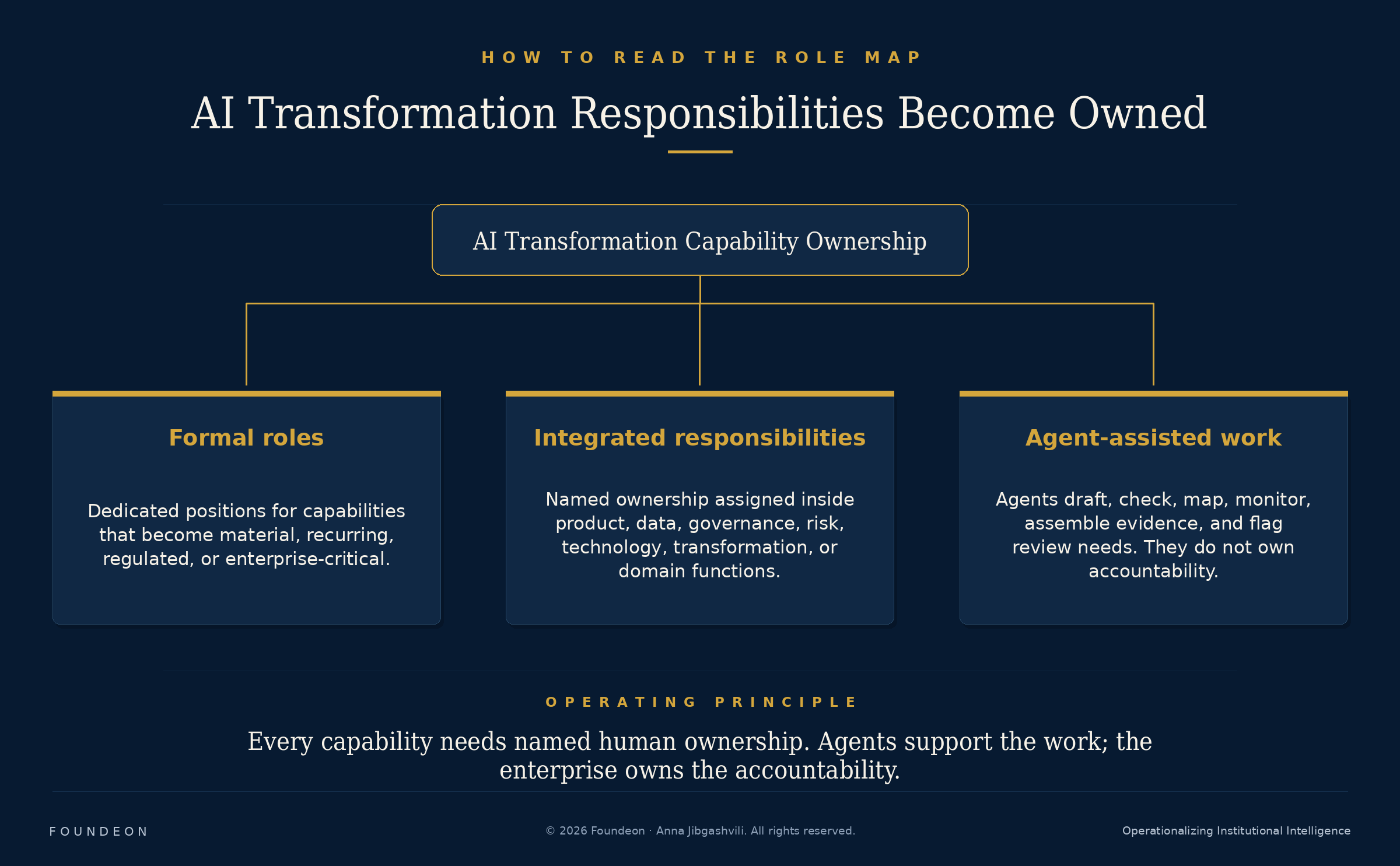
The operating principle: AI transformation requires explicit ownership for every capability that determines whether AI can be governed, audited, trusted, changed, and safely scaled. Headcount follows materiality.
Human oversight is a decision authority layer
Human oversight is the enterprise’s decision authority layer. It defines where judgment lives, who has the right to intervene, what evidence is required, when escalation is triggered, and how accountability is preserved when AI participates in work.
Too often, “human in the loop” is treated as a checkbox. A person is placed somewhere in the process without enough context, evidence, authority, time, or escalation rights to make a meaningful decision. That is symbolic control. Distinguishing meaningful oversight from symbolic oversight is itself a capability. The role map names it as an Oversight Quality Reviewer, whose work is to confirm that every human decision point has the authority, evidence, and escalation rights it needs to function.
Meaningful oversight has to be designed. A Human Decision-Node Designer defines where human judgment must structurally appear in an AI workflow: what decision the human owns, what evidence they need, what authority they have to override the AI, when escalation is required, how the decision is recorded, and who remains accountable if the AI recommendation is followed or rejected.
Designing the judgment point is half the work. Someone also has to hold it. A Human Override Owner defines when and how humans can override AI recommendations or agent actions and exercises that authority when the moment arrives. An Exception Judgment Specialist handles cases where policy, data, context, and model output conflict, as well as cases for which no workflow is anticipated. These are runtime roles. They exist because oversight that is designed but never staffed is symbolic control by another name.
As AI autonomy increases, this design work becomes more important. The enterprise needs humans to own the decision architecture that determines where review is required, where automation is acceptable, where escalation is mandatory, and where AI should stay out entirely. A reviewer without authority is a formality. An approval point without evidence is a formality. If the human role lacks context, authority, evidence, and responsibility, it will fail to protect the enterprise when AI enters the decision-making process.
The use case lifecycle
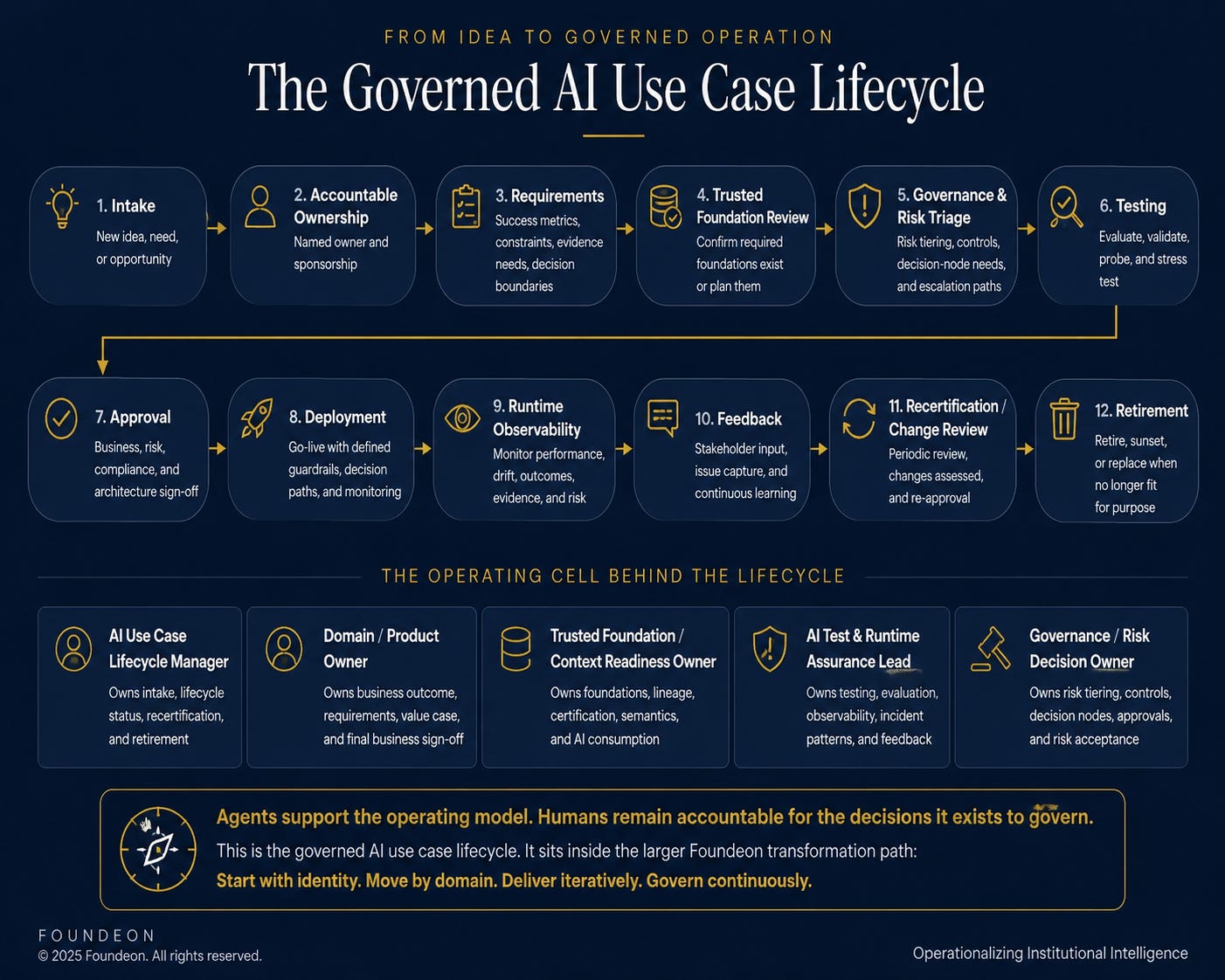
Another capability that requires explicit ownership is the AI use case lifecycle. A governed AI use case moves through intake, business ownership, requirements definition, foundation dependency review, risk and governance triage, testing, approval, deployment readiness, observability, feedback, recertification, and eventual retirement. Without that lifecycle view, AI transformation becomes a collection of disconnected experiments. With it, AI becomes a governed operating capability.
This lifecycle can be coordinated by a single bundled role. An AI Use Case Lifecycle Manager owns the end-to-end lifecycle of an AI use case from intake and prioritization through requirements sign-off, foundation dependency review, testing, controlled deployment, observability, feedback, recertification, and retirement. One person carries what could otherwise fragment into separate intake, requirements, change control, and observability titles. The role is a clean bridge between product, governance, data, risk, and operations.
Requirements
This changes how enterprises should think about requirements. AI requirements differ from those of conventional software. A new AI workflow, agent, or data product dependency needs clarity on business purpose, approved scope, data dependencies, decision boundaries, evidence requirements, escalation paths, human decision nodes, testing conditions, and lifecycle status. Requirements sign-off in this context is the moment where the enterprise confirms what it is asking AI to do and what it is refusing to allow AI to do.
That sign-off needs business ownership, domain knowledge, data readiness, governance review, and risk judgment beyond the technical team. If an AI use case depends on a data product that lacks certification, a policy that is ambiguous, a workflow with unclear decision rights, or an agent that has yet to be bounded, the enterprise should know that before deployment. Requirements are where many of those risks first become visible. All of this assumes the enterprise owns the substrate on which its AI operates: the semantic contracts, decision boundaries, and identity structures that determine how AI reasons about the enterprise it serves. That ownership question comes before everything else in this article.
Testing
AI testing has to go beyond whether the system technically works. It has to test whether the system behaves appropriately under uncertainty, missing information, conflicting policies, edge cases, adversarial inputs, unclear instructions, and high-consequence scenarios. Testing also needs to verify that the human decision node works, which is why the role map pairs the Human Decision-Node Designer with a Human Decision-Node Tester. Does the human receive enough evidence? Do they understand why the AI escalated? Can they override the recommendation? Is the decision recorded? Is the accountability chain clear?
The enterprise needs people who can test the workflow around the model: the handoff between AI and humans, the control points, the escalation logic, the evidence trail, and the conditions under which the AI should stop. This is runtime assurance.
Observability
Observability is another area where the human role is understated. AI observability is usually discussed as a technical function, and it has a technical foundation. In an enterprise context, observability is also a governance and accountability function. Knowing whether an AI system is running is the floor. The enterprise needs to know whether the system is behaving within the purpose, authority, context, and boundaries for which it was approved.
That requires monitoring performance alongside unexpected outputs, drift, escalation patterns, policy conflicts, usage anomalies, failed controls, workflow breakpoints, human override patterns, and agent behavior outside approved scope. The title may vary. The responsibility is essential. When AI participates in work, someone has to watch whether it remains aligned with the role it was approved to play.
Where agents belong
Agents can make this operating model easier to run. A Use Case Intake Agent can check whether a proposed use case has an owner, a value case, a risk tier, a data dependency, and a governance path. A Requirements Drafting Agent can turn business intent into draft requirements, assumptions, open questions, and control needs. A Foundation Dependency Agent can identify which data products, policies, systems, owners, and semantic definitions the use case depends on. A Testing Scenario Agent can generate edge cases, ambiguity tests, missing-data scenarios, policy-conflict cases, and failure modes. An Observability Agent can monitor logs, escalation trends, drift signals, and unexpected activity. An Audit Packet Agent can assemble approvals, requirements, decision records, evidence, versions, dependencies, and escalation history. A Recertification Agent can flag when a change to a use case, agent, data product, workflow, or policy requires review.
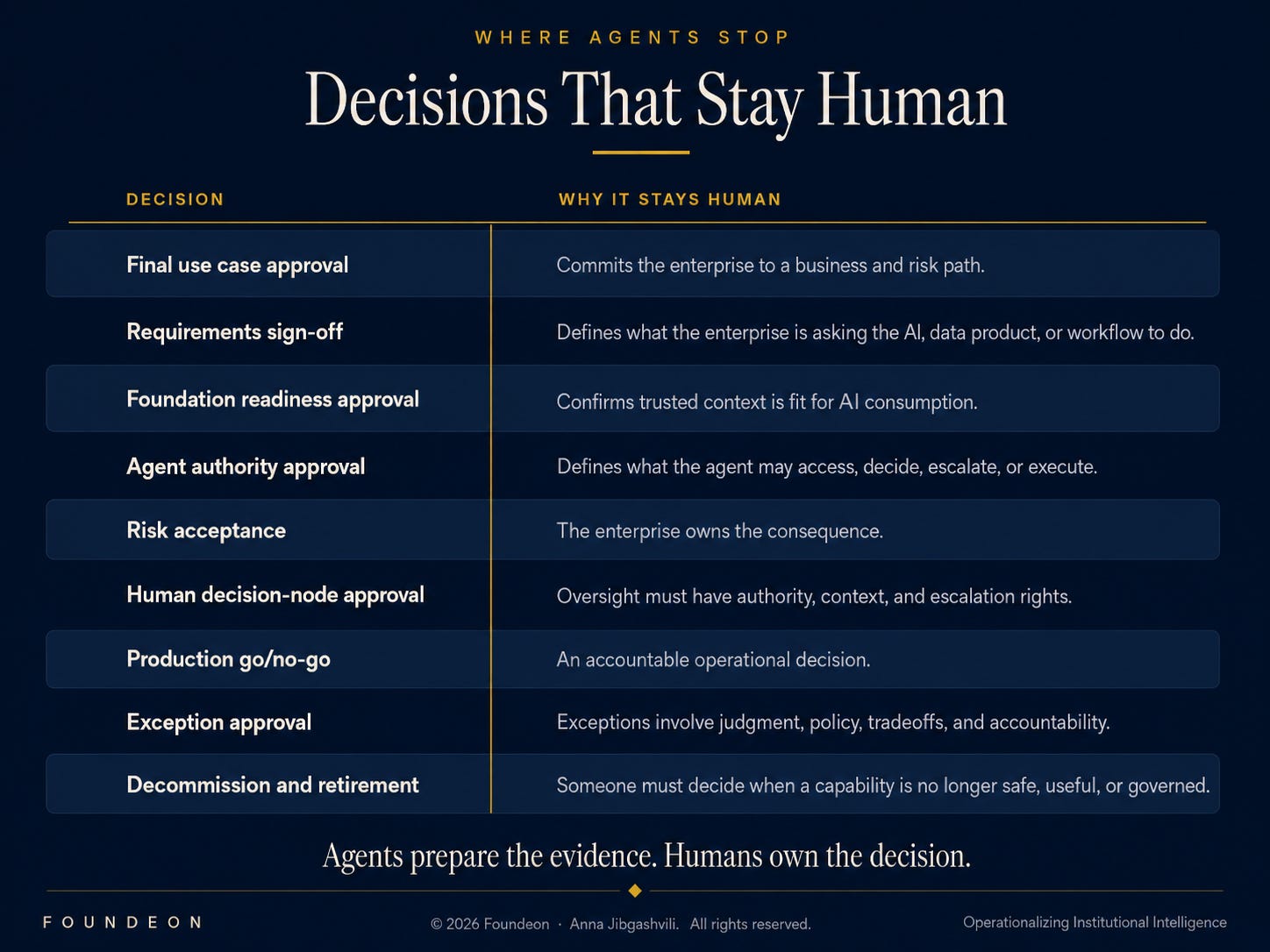
That is the right use of agents in AI governance. Agents prepare, detect, route, monitor, summarize, compare, and document. The human function decides, approves, accepts risk, and remains accountable. Certain decisions stay human-owned even when agents prepare all the evidence:
The operating cell
A practical operating model can begin with a five-role operating cell, with each role carrying bundled responsibilities and agents supporting the work around it.
FDP - foundational data product
Agents support the operating model. Humans remain accountable for the enterprise decisions the operating model exists to govern.
The redistribution
This is the practical workforce shift created by AI transformation: a redistribution of responsibility around the points where AI begins to affect work, decisions, governance, and accountability. When AI automates more execution, the human role moves upward. The execution layer becomes more agentic, while the design, supervision, governance, and accountability layers become more important.
Even if an agent monitors drift, a human still defines which kind of drift matters. If an agent drafts requirements, a human still decides whether those requirements reflect business intent, risk, policy, and accountability. If an agent generates test scenarios, a human still decides which failures are acceptable. If an agent assembles an audit packet, a human still determines whether the evidence is sufficient. The enterprise owns the consequence. The customer relationship, the regulatory obligation, the institutional values, the risk decision, the meaning of the work, and the consequences of getting the decision wrong belong to the enterprise.
Why these roles are missing from the job market
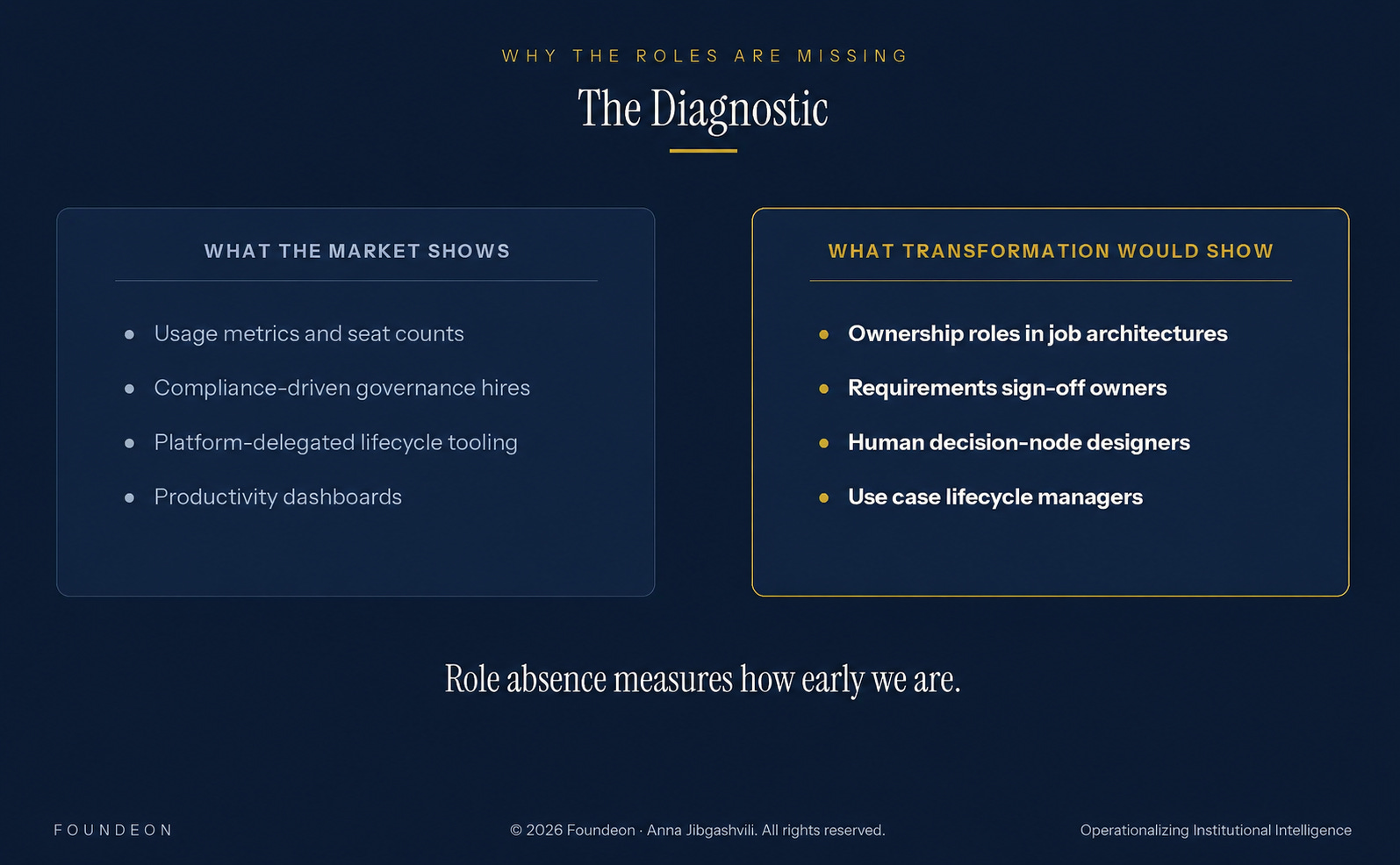
A reasonable objection: if AI transformation creates this workforce, job boards should show it. They do not, and the explanation fits in a sentence. The visible job market is still organized around adoption, not around ownership of transformation.
What the market calls transformation is adoption. Enterprises are deploying copilots, counting seats, measuring prompts, and reporting productivity gains. Those are usage metrics. Transformation begins when AI enters workflows with consequences, and the enterprise must decide what it is willing to let AI consume, influence, decide, and change. That decision creates the ownership work this article describes. The work has not been created because the decision has not been made.
The roles mapped here are examples, drawn from how workflows restructure when AI becomes an operating participant. The complete picture will be larger, and it will look different in every enterprise. The governance hiring the market does show, compliance leads, and risk managers recruited against regulatory deadlines, govern outcomes on substrates nobody owns. Regulation manufactures oversight roles. Transformation manufactures ownership roles. They are different workforces. What stays constant is the diagnostic: when these responsibilities start appearing in job architectures, as titles or as explicit additions to existing ones, transformation has begun. Their absence today measures how early we are.
This is also the opportunity. Enterprises that assign this ownership now, while the market is still counting seats, will define their own operating logic before AI does so for them. The rest will accumulate usage and call it transformation.