

Redesign the Work First
Operationalizing Institutional Intelligence

A seven-part guide to rebuilding work, capability, roles, development, and education in the order AI transformation requires
AI transformation changes how we work. Enterprises that choose to transform will define what the new work should become.
The common response should begin with the workforce. Organizations rewrite job descriptions, create new skills taxonomies, launch reskilling initiatives, establish AI academies, and ask universities to prepare people for roles that are still being formed.
These actions may all be necessary. They are being asked to operate without a stable design input.
An enterprise cannot define its future workforce until it has defined its future work.
That is the premise behind Redesign the Work First, a seven-part Foundeon guide series that is now complete.
The series is free, requires no email address, and is available for organizations, educators, workforce leaders, and individuals to keep and share.
The missing step in the workforce conversation
Part I was written in response to the World Economic Forum and PwC framework for safeguarding and reinventing entry-level work.
The framework identifies four important dimensions:
Job access
Job design
Talent pipelines
Education and skill alignment
Each dimension is valid and depends on a decision that precedes it. Before an organization redesigns a job, it must redesign the work that the job contains.
Without that step, job redesign becomes an exercise in redistributing the tasks of the current operating model. Skills are inferred from existing positions. Development programs prepare people for responsibilities that may soon disappear. Education providers receive broad signals about AI literacy rather than specific evidence about the capabilities enterprises will need.
The result is activity without a coherent future-state design.
The workforce cannot move ahead of the enterprise. It can only form around the work the enterprise has chosen to create.
The design order
Parts II through VI establish a five-step sequence.
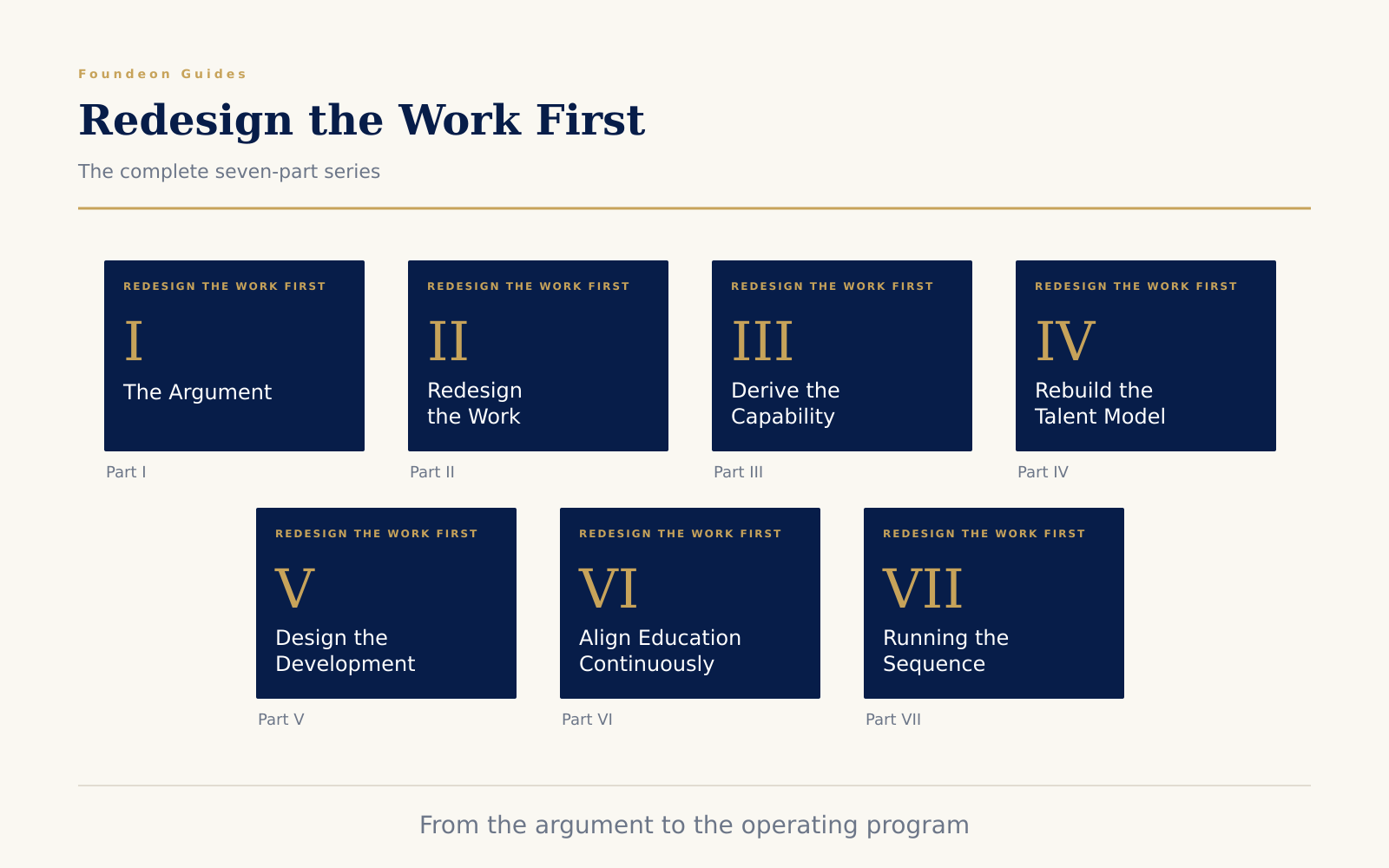
Each step produces the input required by the next. The sequence begins inside the workflow and ends at the boundary between the enterprise and the education systems that supply its talent.
Step one: Redesign the work
AI deployment often begins with the current workflow. Teams identify tasks that appear automatable, introduce a tool, and then adjust roles around the resulting changes. That approach treats the existing workflow as a fixed design.
It preserves its handoffs, delays, duplicated controls, information gaps, and assumptions about who should perform each activity. Technology may accelerate the workflow while leaving its underlying logic intact.
Work redesign begins differently.
The enterprise first defines the future-state workflow. It determines which stages should be eliminated, combined, redesigned, automated, augmented, or retained under human authority. Each disposition carries a rationale. Decision rights, escalation points, evidence requirements, and human responsibilities are designed into the workflow before deployment.
This creates the first dependable input into workforce planning: a defined composition of future work.
Step two: Derive the capability
Capability requirements should be read from the work the enterprise has designed.
They should not be inherited from job descriptions created for the operating model being replaced.
A future-state workflow reveals the domain knowledge, systems fluency, judgment, coordination, and authority required at each stage. It also exposes the distance between the capability the organization has and the capability it will need.
That distance must become specific.
A statement such as “employees need more AI skills” cannot support workforce planning. A capability delta must identify what is missing, where it is needed, how much is required, and by when.
Capability becomes an output of work design rather than a general aspiration attached to transformation.
Step three: Rebuild the talent model
Organizations commonly treat roles as durable containers. Responsibilities are added or removed while titles, career ladders, and organizational structures remain largely fixed.
AI makes that model increasingly difficult to sustain.
When work changes continuously, roles must be assembled from the responsibilities the work creates. They must also be capable of being reassembled when the workflow changes again.
This does not mean that every technology change should trigger an organizational restructuring. It means the enterprise must understand the relationship between workflow stages, responsibilities, capability requirements, and roles.
That relationship makes internal mobility more precise. Movement can be evaluated through capability adjacency rather than title similarity. Career paths can follow the accumulation of judgment and responsibility instead of the historical sequence of positions within a department.
The talent model becomes responsive to the operating model.
Step four: Design the development
Entry-level work has always performed two functions.
It produced output, and it formed judgment.
Early-career professionals learned through repetition, observation, review, correction, and gradual exposure to consequences. Much of that formation was never formally designed. It arrived as a byproduct of routine work.
AI is increasingly absorbing the work through which that judgment developed.
When the activity disappears, the development it once produced disappears with it. An enterprise cannot assume that employees will somehow acquire the same judgment through a shorter training course or access to an AI assistant.
Formation becomes an explicit design obligation.
Organizations must determine which experiences develop judgment, how those experiences will be recreated, who owns them, how progress will be measured, and what the development pathway will cost.
Enterprises that redesign their workflows and identify the capabilities needed to operate them will do more than transform their own organizations. They will help shape the development of the future workforce.
Step five: Align education continuously
Education systems are frequently asked to align with the needs of employers.
They cannot align to capability requirements that employers themselves have not defined.
Once an enterprise has redesigned the work, derived the capability, rebuilt the role model, and established its formation pathways, it can provide a much clearer demand signal.
That signal can shape degree programs, professional education, certifications, apprenticeships, internal academies, and other learning channels. It can specify the knowledge, systems fluency, judgment, and experience required for identifiable responsibilities. The relationship must also remain continuous.
The future of work is not a destination that will be reached through one curriculum revision. Enterprise workflows will continue to change, which means capability requirements and development pathways must change with them.
Education alignment must become an ongoing relationship between enterprises and education providers, with capability requirements updated as the work changes.
One workflow, followed to the end
A framework becomes useful when its outputs remain connected across every stage. For that reason, one worked example runs through the full series.
The example begins with a commercial credit renewal workflow at the fictional Bank of Elmsworth. The workflow is followed through seven stages and four work dispositions.
From the redesigned work, the example derives seven capability profiles. Those capabilities are translated into responsibilities and assembled into four roles, with a career path running through them.
The resulting talent model then becomes the basis for a thirty-six-month formation pathway. Finally, the development requirements are connected to four education channels.
The example does not reset from one guide to the next. The same workflow is carried all the way through.
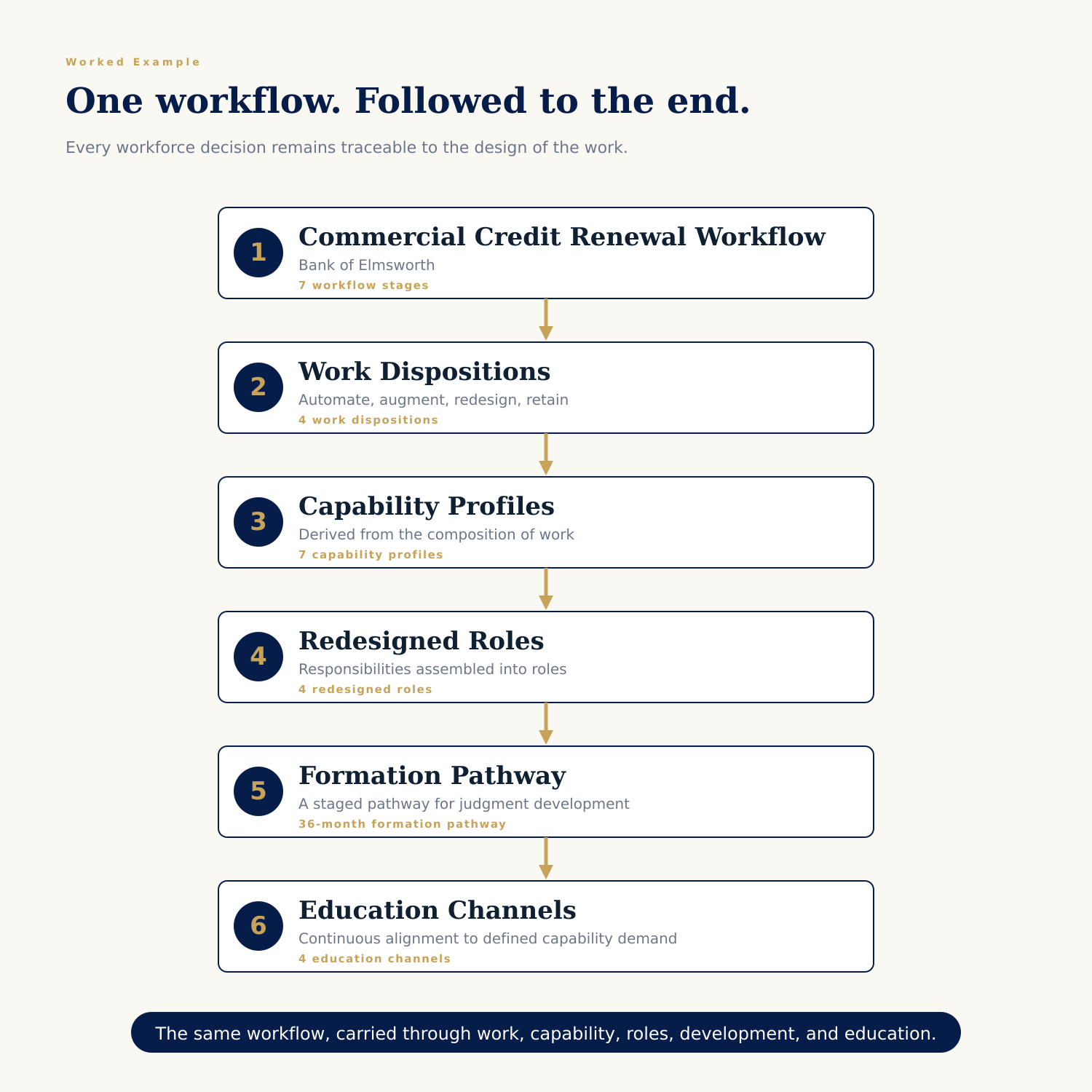
That continuity matters because workforce strategies often contain individually reasonable components that cannot be traced back to a common operating model. The skills strategy does not clearly follow from the workflow. The career architecture does not clearly follow from the capability model. The learning program does not clearly prepare people for the responsibilities the organization has created.
The guides establish that traceability.
From framework to enterprise program
Part VII brings the five steps together as one transformation program.
The sequence is serial within a workflow. Work must be designed before its capability requirements can be derived. Capability must be defined before responsibilities and roles can be assembled. Development must respond to the responsibilities people will carry. Education alignment requires a defined demand signal.
Across an enterprise portfolio, the work can be pipelined.
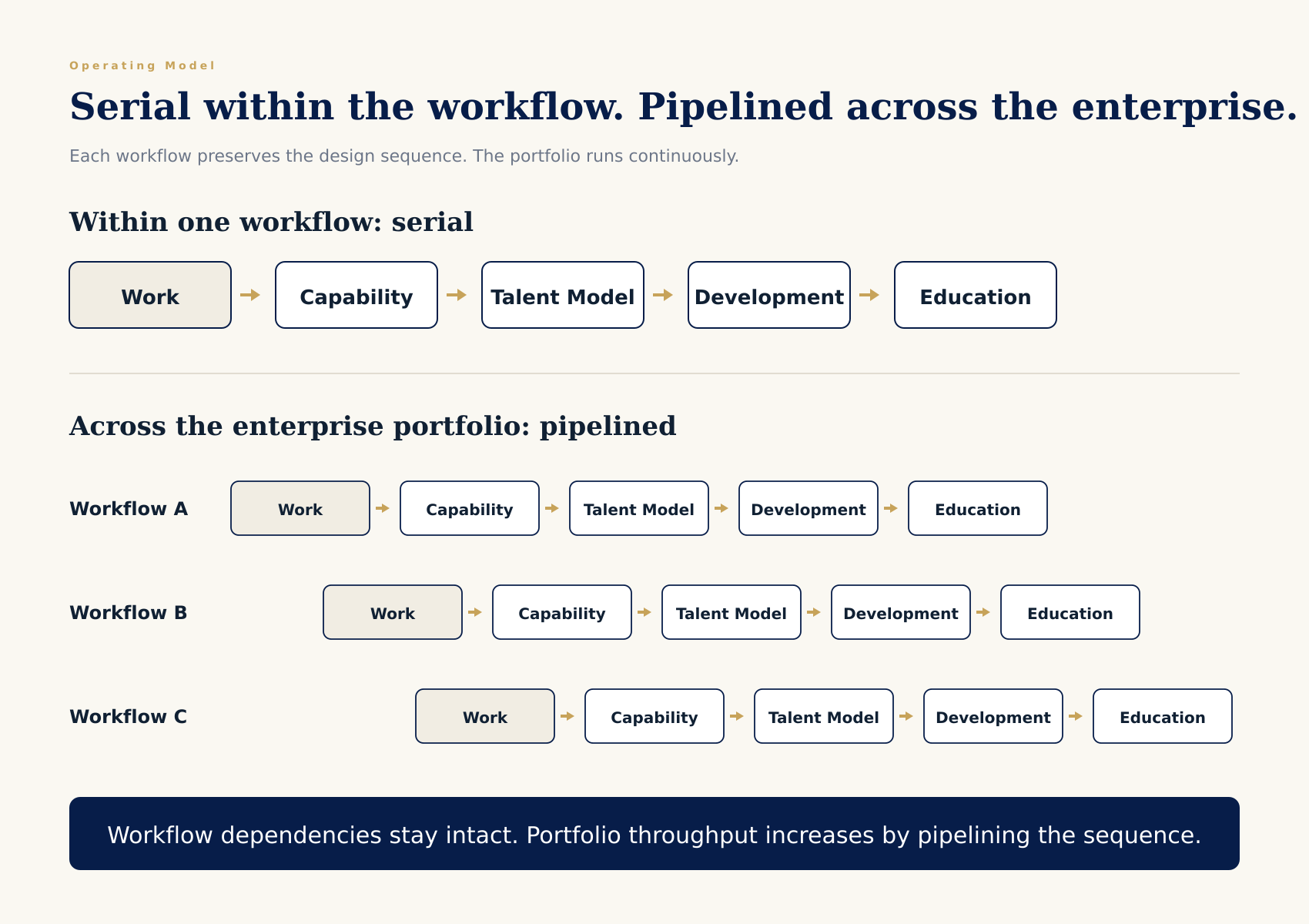
One workflow may be moving through capability design while another enters role reconstruction and a third begins development planning. This allows the organization to progress continuously without collapsing the dependencies within each workflow.
Part VII also addresses ownership.
Workforce transformation cannot be delegated exclusively to Human Resources because the sequence begins inside operating workflows. Technology may enable the redesign, but capability, authority, development, and institutional judgment extend well beyond deployment. Business leaders are equally essential, yet the resulting changes cross organizational and educational boundaries. Each step therefore requires a defined owner, participating functions, and an explicit handoff to the next stage.
Each step requires a defined owner, a set of participating functions, and an explicit handoff to the next stage.
The guide translates that model into an initial ninety-day program so that organizations can begin producing decisions and artifacts rather than spending a quarter debating the transformation structure.
What the enterprise should own
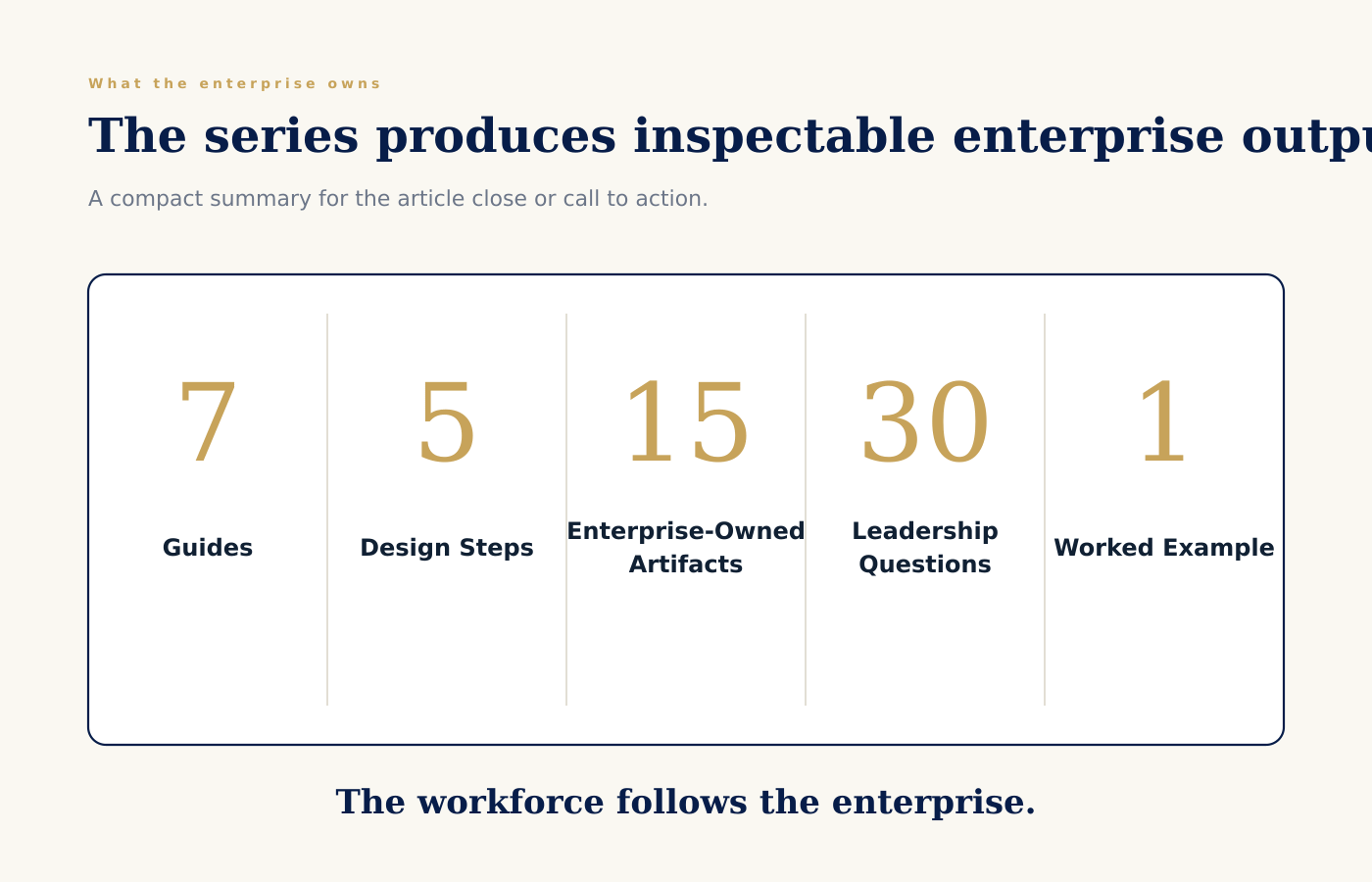
Across Parts II through VI, the series produces fifteen enterprise-owned artifacts and thirty questions that a leadership team should be able to answer.
The artifacts make the transformation inspectable.
They allow leaders to see how a workflow decision created a capability requirement, how that requirement created a responsibility, how responsibilities formed a role, and how the role created a development obligation.
This is important because workforce transformation is frequently discussed through forecasts, principles, and aggregate skills data. Those perspectives are useful, but they do not tell an individual enterprise what it is building. The enterprise must own that answer.
It must be able to explain how its work will operate, which capabilities the work requires, where human judgment remains essential, how responsibilities are distributed, how people will develop, and how external education systems will receive a reliable signal.
Without those answers, the workforce strategy remains detached from the transformation it is intended to support.
Why I made the series freely available
The consequences of getting this sequence wrong extend beyond a single organization.
They affect entry-level access, professional formation, internal mobility, institutional knowledge, and the ability of education systems to prepare people for meaningful work.
I wanted the complete method to be available without a registration form or an abbreviated preview.
Each guide can be used independently, but the value is in the sequence. Part I establishes the argument. Parts II through VI provide the five design steps. Part VII turns them into one program.
Together, they offer an enterprise a place to begin and a standard against which to evaluate its own workforce transformation. The future workforce cannot be designed from forecasts alone.
The enterprise defines the work.
The work determines the capability.
Capability shapes responsibilities and roles.
Those roles create development obligations.
Education aligns to a demand signal that has finally become concrete.
The workforce follows the enterprise.
All seven parts of Redesign the Work First are available at: foundeon.com/guides
Free. No email required. Yours to keep and to share.
An excellent and unusually coherent framework. The central issue is not merely redesigning jobs, but restoring the correct causal order: work, capability, authority, roles, development, and education.
When that sequence is reversed, organisations do not transform; they automate inherited dysfunction and reproduce it at machine speed. AI may accelerate execution, but it also exposes whether the underlying operating architecture was coherent in the first place.
The point about entry-level work is especially important. When routine tasks disappear, the judgment once formed through repetition, correction, and exposure to consequences may disappear with them. That creates an invisible capability deficit unless professional formation is deliberately redesigned.
Transformation is therefore not primarily a technology programme. It is an exercise in institutional architecture.